
Anti-Wrinkle Treatments
Anti-wrinkle treatments are used to soften dynamic lines while maintaining natural facial expression. A measured, conservative approach is taken to ensure results appear refreshed rather than frozen.
From £200
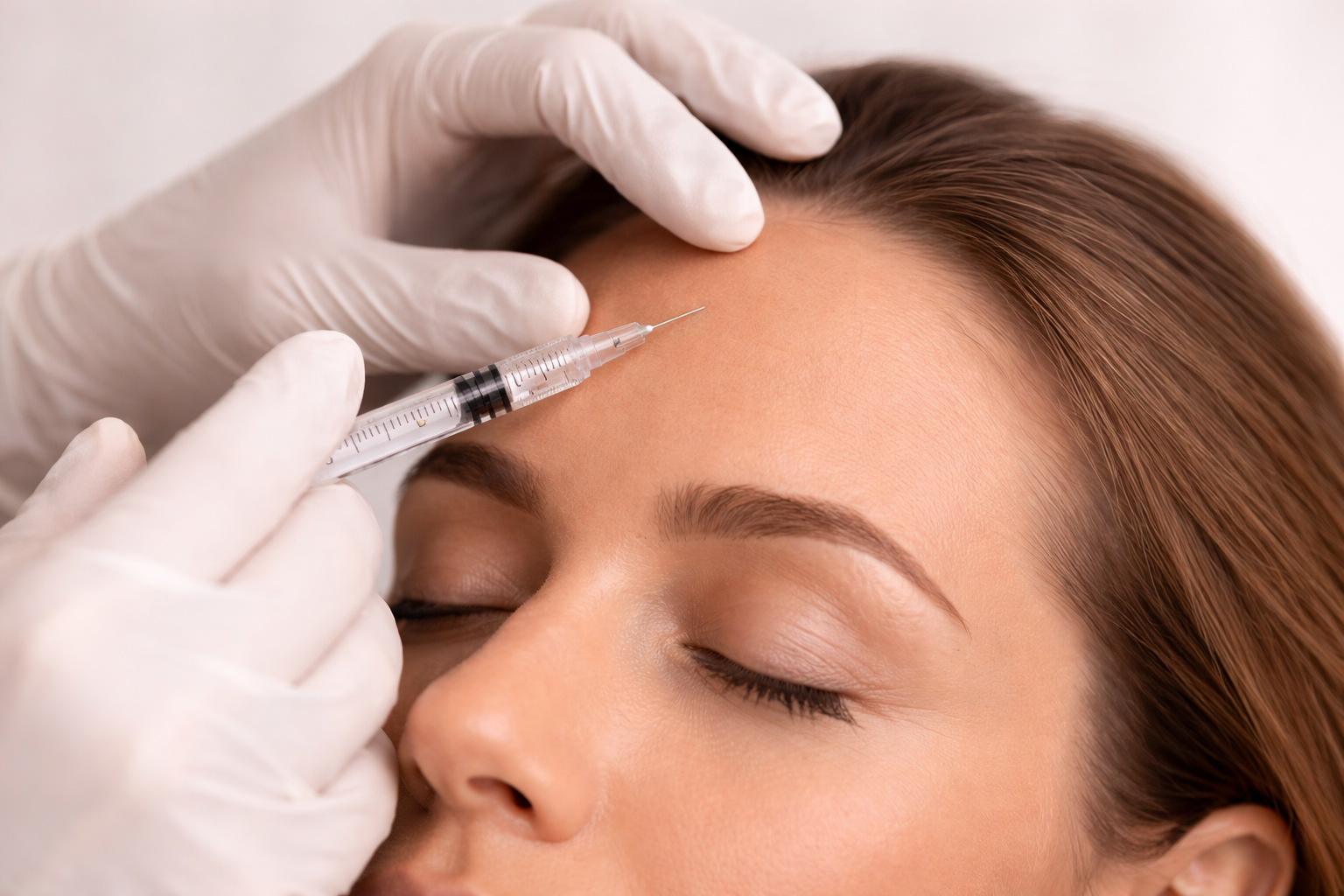
1. What anti-wrinkle injections do
Repeated facial movement folds the skin in the same places over years. Eventually those folds stay visible at rest. Anti-wrinkle injections work by temporarily reducing the strength of the specific muscles causing that folding, which allows the overlying skin to soften.
They work on dynamic lines — lines caused by movement. They do not work on lines caused by volume loss or sun damage, which need a different approach. Part of the consultation is establishing which you actually have, because the wrong treatment on the wrong line produces disappointment.
2. Areas treated
Upper face
The three standard areas are the glabella (frown lines between the brows), the frontalis (horizontal forehead lines) and the orbicularis oculi (crow's feet at the outer eyes). These are usually treated together or in combination, since the muscles work against each other.
Masseter — jaw slimming
Treatment of the masseter muscle softens a heavy or square lower face and can relieve jaw clenching and associated tension headaches.
Nefertiti lift
Treatment along the jawline and platysmal bands to soften the appearance of the jaw and neck junction.
Underarms
Excessive underarm sweating is treated with the same class of medicine, at a different dose and site. This is covered separately — see Hyperhidrosis Treatment.
3. Why conservative dosing matters
The most common complaint after anti-wrinkle treatment is not that it did too little. It is that the forehead is flat, the brows have dropped, or the face no longer moves in a way that reads as natural.
Dr Ashi starts at the lower end of the effective dose range and reviews at two weeks. If more is needed, more is added. Working the other way round is not possible — you cannot remove product once it is placed, and you wait three to four months for it to wear off.
This is slower. It is also why patients describe results as looking rested rather than treated.
4. What people mean when they search for Botox in Kingston
Botox is a brand name. It refers to one specific botulinum toxin type A product, manufactured by Allergan. Because it was the first to market, the brand name is used colloquially for the whole treatment category, in the way that Hoover is used for vacuum cleaners.
There are several licensed botulinum toxin type A products used in UK aesthetic practice, including Botox, Azzalure, Bocouture and Dysport. They differ in unit strength and dilution but work by the same mechanism.
All of them are prescription-only medicines. That has two consequences for patients. First, they can legally be prescribed only by a qualified prescriber following a face-to-face assessment. Second, UK advertising rules prevent clinics from advertising them to the public by name, which is why the treatment is described here as anti-wrinkle injections rather than by brand.
If you searched for Botox in Kingston, this is the treatment you were looking for. Which product is appropriate for you is a prescribing decision Dr Ashi makes at consultation.
5. What to expect
Before
A full consultation and medical assessment. Avoid alcohol for twenty-four hours beforehand. Tell Dr Ashi about any blood-thinning medication or supplements.
During
Treatment takes ten to fifteen minutes. A very fine needle is used. Most patients describe it as a brief sharp scratch rather than pain, and no anaesthetic is needed.
After
Stay upright for four hours, avoid exercise and heat for twenty-four hours, and do not rub the treated areas. Small raised bumps at the injection sites settle within an hour. Occasional light bruising resolves within a few days.
Results
Softening begins at three to five days and is complete at around two weeks. Results last three to four months for most patients, and often longer with repeated treatment as the muscles adapt.
6. Who is not suitable
Anti-wrinkle injections are not offered to anyone who is pregnant or breastfeeding, has a neuromuscular condition such as myasthenia gravis, has an infection at the treatment site, or has a known allergy to botulinum toxin. Certain medications interact with it. This is assessed at consultation, and treatment is declined where it is not appropriate.
7. Prices
| One area | £200 |
| Two areas | £250 |
| Three areas | £300 |
| Masseter, jaw slimming | £300 |
| Nefertiti lift | from £350 |
| Consultation | £40 |
Consultation fee is redeemable against treatment. A two-week review is included with every treatment.
8. Anti-wrinkle injections near Kingston
The clinic is in Kingston upon Thames, KT2, with patients travelling from:
- Norbiton
- Coombe
- Surbiton
- New Malden
- Richmond
- Teddington
- Wimbledon
Appointments run Monday to Saturday. Clinic address and opening hours.
9. Frequently asked questions
Will my face look frozen?
Not with conservative dosing. The aim is to reduce the strength of movement, not eliminate it. Dr Ashi starts low and reviews at two weeks so the result can be built up rather than corrected downwards, which is not possible.
How long do anti-wrinkle injections last?
Typically three to four months. This varies with metabolism, dose, muscle strength and how physically active you are.
Does it hurt?
Most patients find it very tolerable. The needle is extremely fine and treatment takes around ten minutes.
Can I go back to work afterwards?
Yes. There is no downtime beyond avoiding exercise, heat and lying flat for the rest of the day.
What is the difference between Botox and anti-wrinkle injections?
Botox is a brand of botulinum toxin type A. Anti-wrinkle injections is the general term for treatment using any licensed botulinum toxin product. See section 4 above.
At what age should I start?
There is no correct age. The clinical question is whether you have dynamic lines that bother you and whether treatment will improve them. Some patients in their late twenties benefit; some in their forties do not need it.